Business Resources
Business Resources for UAE SMEs
Practical guides on UAE corporate tax, VAT, accounting and compliance, written by the people who handle the work day to day.
This library collects short, practical articles on the tax and accounting questions UAE SMEs deal with most: corporate tax registration and filing, VAT registration and returns, e-invoicing, free zone rules, penalties and bookkeeping. It is written for founders, owner-managers and whoever looks after the finances in the business, whether that is a mainland company, a free zone entity or a sole establishment.
Most articles answer one question. When do I have to register for corporate tax, and what happens if I am late? Does my free zone company still pay 0%? When does VAT registration become mandatory, and how do I file a return on EmaraTax? What records do I have to keep, and for how long? Each article gives the rule, the deadline or threshold that applies and the practical steps, and links to the Ministry of Finance and Federal Tax Authority sources where they exist.
UAE tax rules have changed often since corporate tax started in June 2023, and they are still changing. Small Business Relief now runs for tax periods ending on or before 31 December 2029, VAT law amendments took effect in 2026, and mandatory e-invoicing is on its way. We update articles when the rules move and show the last-updated date on each one. Treat them as general information, not advice on your specific situation.
For longer walkthroughs, see the in-depth guides further down this page. If you want the work done for you, TaxBox offers VAT return filing, corporate tax filing and monthly bookkeeping on fixed monthly fees.

You must register for UAE VAT once taxable supplies and imports pass AED 375,000. Here is who has to register, the voluntary threshold, the deadline, the late-registration penalty and how to apply on EmaraTax.

A UAE free zone company pays 0% corporate tax only if it is a Qualifying Free Zone Person and only on its Qualifying Income. Here are the conditions, the de minimis rule and what you still have to file.

Bookkeeping services in Dubai keep your records accurate so VAT and corporate tax filings are right. Here is what a service covers, what UAE law makes you keep and for how long, and what to check before you hire.

Federal Decree-Law No. 16 of 2025 changed UAE VAT from 1 January 2026, adding a five-year limit on refund claims. Penalty cuts followed in April. Here is what changed and what to check in your business.

The corporate tax return for a 31 December 2025 year-end was due on 30 September 2026. If you missed it, here is the FTA's published late-filing penalty, how it builds each month and the steps to take now.
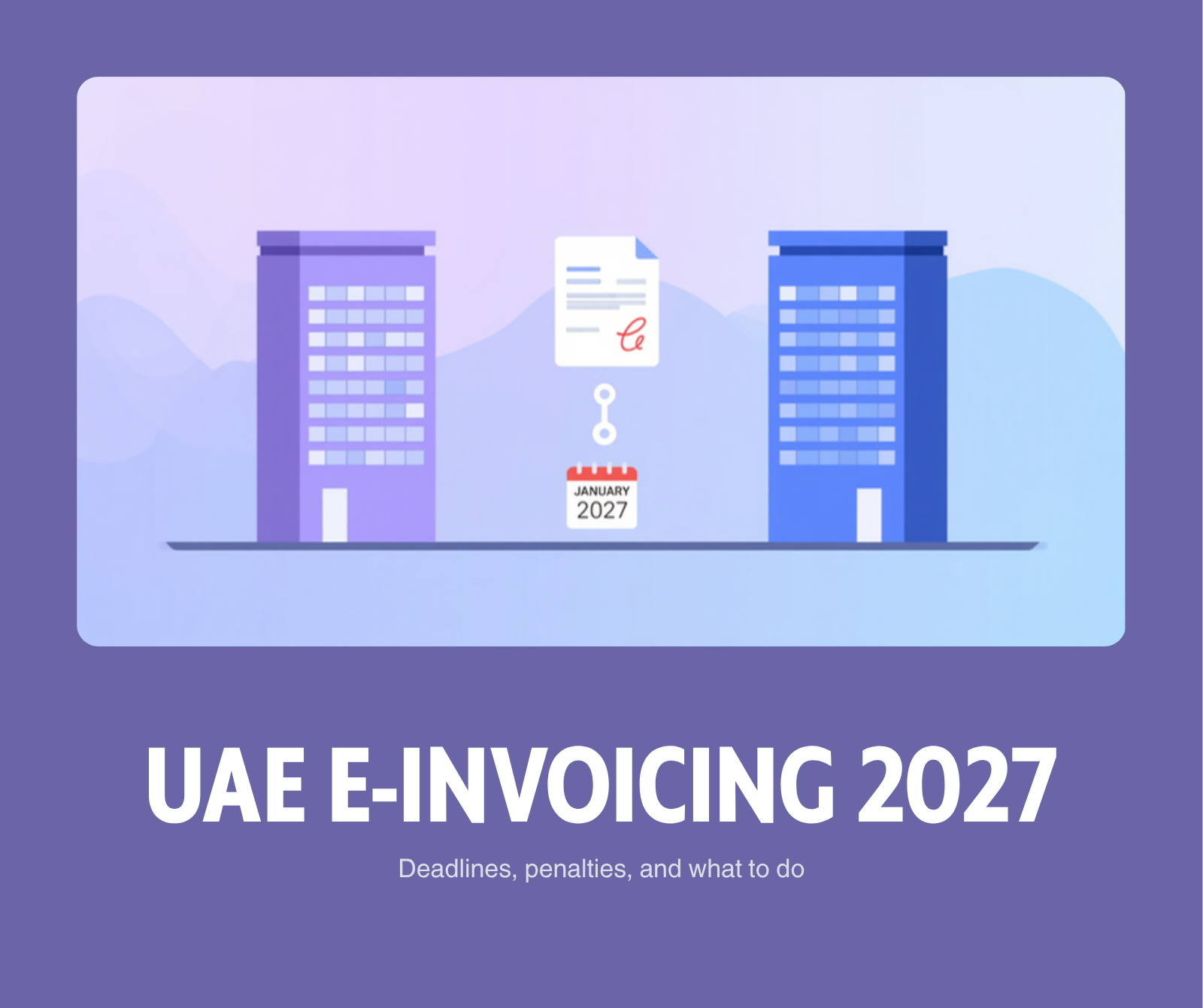
E-invoicing becomes mandatory in the UAE from 1 January 2027 for businesses with revenue of AED 50 million or more, and from 1 July 2027 for everyone else. Here is who is affected, the deadlines, the penalties and how to prepare.

A complete guide to corporate tax filing in Dubai: who must file, the 9-month deadline rule, EmaraTax steps, penalties, and how Small Business Relief works for tax periods ending on or before 31 December 2029.

Corporate tax registration is mandatory for almost every UAE business — even at 0%, even in a free zone. This 2026 guide breaks down every deadline by entity type, the AED 10,000 penalty for registering late, and how the FTA's waiver lets you cancel or refund it.

Corporate tax registration is done online through the FTA's EmaraTax portal and is mandatory for almost every UAE business, even those taxed at 0%.

Small Business Relief has been extended. Under Ministerial Decision No. 131 of 2026, businesses with revenue of AED 3 million or less can elect it for tax periods ending on or before 31 December 2029. Here is who qualifies, what you still have to file, and when electing it is not the best choice.

Hit with a AED 10,000 late corporate tax registration fine — or worried you're about to be? The FTA's penalty waiver can cancel it entirely, or refund it if you've already paid, as long as you file your first return within 7 months of your first tax period's end. Here's exactly how it works and how to find your deadline.

Value Added Tax remains a critical compliance obligation for UAE small businesses. This 2026 guide covers everything from EmaraTax portal steps to avoiding automatic FTA penalties.

Since the UAE introduced its federal corporate tax regime in June 2023, every business must understand their legal obligations to avoid financial consequences and FTA penalties.

Bookkeeping mistakes in the UAE can lead to expensive compliance failures. Learn how to avoid mixing personal finances, missing tax invoices, and other common errors.

Choosing a tax consultant in Dubai is a critical decision for UAE SMEs. This guide covers FTA registration, industry experience, and red flags to watch for in 2026.

Selecting the right accounting partner is a critical risk management decision. This 2026 guide explores how to evaluate UAE expertise, technology, and pricing structures.
Guides
In-depth guides
Longer-form walkthroughs on hiring an accountant, choosing a firm, and getting your books UAE-ready.
Who must file, the 9-month deadline rule, EmaraTax steps, penalties, and Small Business Relief for tax periods ending on or before 31 December 2029.
A practical guide for UAE founders on what to look for, red flags to avoid, and how to shortlist the right accountant.
Bookkeeping, VAT, Corporate Tax and audit support, what a full-service Dubai accounting firm actually delivers.
How VAT-ready monthly bookkeeping works, what it includes, and typical pricing for UAE SMEs.